Sneak peek: One Poppy Weeps!
over 2 years ago
– Tue, May 14, 2024 at 06:48:18 PM
One Poppy Weeps, the card of pain, isn't exactly a cheerful one to think about. Like all the cards in the pattern deck, though, it has both its positive and negative sides; after all, sometimes pain now is necessary to avoid more pain later, or it's a warning not to do something that might be dangerous for you.
Apart from what's implied by the card's name, we didn't have a lot to give A.C. in terms of direction for this one; it was an open field for them to decide what they wanted to do with it. Here's what we have for the pencil sketch:
Yowch. Also, poppies don't work that way? I doubt you could stab the stem of one through a person's hand like that. <lol> But who cares: this is a very strong image, one where you will instantly remember the card's basic significance the moment you see it. When Alyc and I saw it, our reaction was basically, "fantastic, no notes."
Well, one note, which is that Alyc was very impressed by A.C.'s ability to do such good hands. Even someone like me, who basically doesn't draw at all, knows that hands are proverbially a pain to draw well, to the point that many artists favor compositions that don't require them to show hands in detail . . .
I can't wait to see this one painted, in all its vivid colors!
--Marie
Solitaire progress!
over 2 years ago
– Wed, May 01, 2024 at 04:07:50 PM
My apologies for this update not coming out on Tuesday as usual -- yesterday just got away from me.
But I'm back with a behind-the-scenes look at development of the solitaire game (aka the patience game, to you non-North Americans). This one poses an interesting challenge because the majority of such games are "builders," meaning that the goal is to assemble cards in sequence, usually by suit: you build up from ace to king, for example, or down from king to ace, or sometimes the starting point is whatever card gets dealt as the foundation.
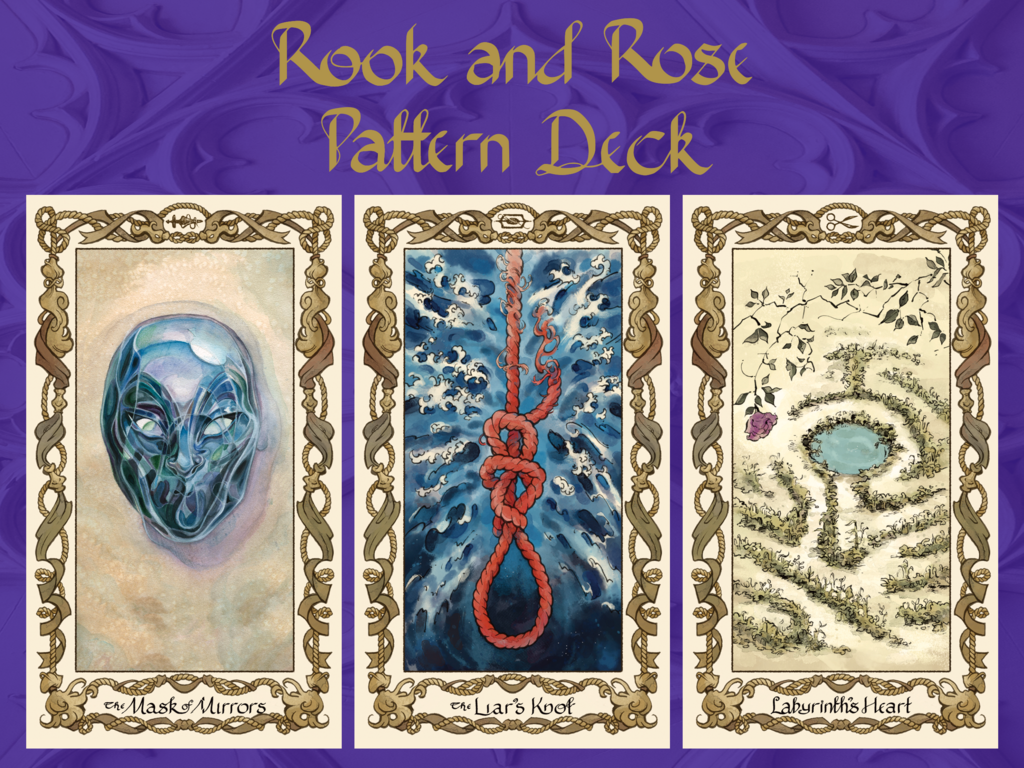
This fundamentally does not work with a non-numbered deck. I'd have to gloss all the card groups -- those styles of names I mentioned a few updates ago -- with numerical identities, so that e.g. the Noun Preposition Noun type like Sword in Hand and Storm Against Stone are 6s and the Noun's Noun type like The Liar's Knot and Labryinth's Heart are 5s . . . which 1) would be awkward for playing, 2) would still run into problems around there being two such cards in each suit, and 3) is not at all the kind of game that would grow organically out of a non-numbered deck. So: builders are Right Out.
The other two types, in terms of mechanics, are pairing and totaling games. The latter require you to select cards that add up to a certain number -- often thirteen, since that works nicely with there being that many cards in a suit (you just count jacks as eleven, queens as twelve, and kings as thirteen). Obviously that doesn't work with a non-numbered deck either, but unlike builders, totaling games aren't right out as a base: you just treat them as being like pairing games, where the point is that a two and a jack go together, and the numbers themselves don't matter. It doesn't work for all of them; I enjoy 11s Up, but part of what makes that one good is the ability to add together multiple cards to get a total of eleven, and now you're back to the specific numerical value mattering. (Also, I could never use that in a game for this setting. Those of you who have read the books know why.)
So mostly I'm looking at pairing games, with some totalers as additional possibilities. Because I haven't created enough challenges for myself, I added two more strictures: I don't want this to be the sort of game that is purely mechanical and luck-based, with no element of skill or strategy, and I also don't want it to be one of those games you can almost never win. With all this in hand, I started looking at existing games for inspiration, and testing out pattern-based variants with my handwritten deck.
And as soon as I did that, I realized there was one factor I had forgotten to take into consideration.
In a Western deck, there are four suits of thirteen cards each, and any card has three others of the same rank. (Plus jokers, but they rarely figure into gameplay.) In a pattern deck, there are three suits of twenty cards each, and any regular card has five others of the same type, while Faces and Masks have either eleven others (if Faces must match with Faces and Masks with Masks) or twenty-three (if Faces are allowed to match with Masks).
This changes the probabilities a lot. I tried playing a few hands of Accordion, which seemed like it was pretty well-suited to non-numerical play, and it worked -- far too well. I won every single hand with trivial ease. That game hinges on collapsing the deck between cards of either the same suit or the same rank that are a certain distance apart, and with the pattern deck, the probability of being able to arrange that spacing is extremely high. I don't want a game where you can play a hundred hands without ever winning, but I also don't want one where you can play a hundred hands without ever losing.
The good news is, I may have found a good game to use as my base. I need to playtest it more; in the handful of rounds I've played so far I haven't yet won a game, but I'm not sure yet if that's poor luck of the draw, insufficient strategy on my part, or the game itself, and if the latter, what happens when I try tweaking the rules slightly. (I've been playing it in the strictest possible form, so I have two possible variants to try that might increase the chances of victory.) For bonus points, its underlying concept even chimes well with the setting, so I'm hoping this one will work out!
I will report back later with the results . . .
--Marie
Sneak peek: The Face of Crowns!
over 2 years ago
– Tue, Apr 16, 2024 at 11:11:33 AM
Alyc and I did a lot of worldbuilding for the Rook and Rose books, but despite what it may sometimes seem like, we didn't actually make decisions about everything in the setting. So as we work with our artists on these cards, we occasionally run into details for which it's an open field.
As a case in point, The Face of Crowns. The only government you see in the novels is the Cinquerat, the five-person council imposed by the Liganti after the death of Kaius Sifigno, and they don't wear crowns. Did the members of the seven-person council that ruled Nadežra before the conquest? What about the other city-states of Vraszan -- what are their governments like? Somebody, somewhere in Vraszenian history, must have worn a crown, and done so long enough and prominently enough that the idea made its way into the pattern deck as a symbol of rulership.
The card doesn't have to answer that question, but we (Alyc, and Avery, and I) do have to decide what we have in mind visually when we say "crown." As you can see, Avery steered away from ye olde stereotypicalle European crown, tending more toward circlets and things that evoke our overall textile/weaving metaphor -- which makes sense, as weaving and knots and so forth are symbols of social interconnection, of which government is one facet:
No finished sketch for this one yet, as we've been prioritizing going through the drafts of possibilities for each card. But feel free to guess which one we leaned toward as the primary basis of the final version!
--Marie
Sneak peek: A Spiraling Fire!
over 2 years ago
– Tue, Apr 02, 2024 at 05:30:26 PM
Those of you who have read Labyrinth's Heart know that early on in that book, Ren learns a Vraszenian dance called the oszefon, also called the campfire dance. It may or may not be apparent from the description we give there, but that dance is essentially the Argentinian tango: as one of the participants says, "the most intimate kind [of dancing] that still involves clothing."
When we named our card of passion A Spiraling Fire, we very much had that mood in mind. So the brief we gave A.C. for this one was, basically, "draw a tango."
Yep, that's what we envisioned! I love the dynamism of this one, even in pencil sketch version, and I can't wait to see the finished art.
--Marie
A peek at card game design
over 2 years ago
– Tue, Mar 19, 2024 at 02:21:29 PM
Cycling back to the card game design part of this Kickstarter . . . it's a really, really good thing that Alyc and I knew, back when we were drafting The Mask of Mirrors, that we would eventually want to crowdfund the deck, and that we'd include games in the project so as to increase its appeal. Because if we hadn't known that, we likely wouldn't have made certain decisions that are foundational for the ability to play games with the deck.
(There still would have been games in the setting. But we would have had to completely handwave how most of them work.)
The first game we came up with was nytsa, because Japanese hanafuda cards are likewise unnumbered, so it was relatively easy to adapt. But honestly, most card games assume a numbered deck. Since we didn't want to stick numbers on the cards -- that would make it feel more like tarot with a thin paint job over the top -- were we just utterly blocked from using the framework of any game played with a numbered deck?
Not if we concealed a structuring principle within the names of the cards.
Normally we list them out by thread. But look at what happens if I regroup them across threads:
- Orin and Orasz, Hare and Hound, Saffron and Salt, Warp and Weft, Dusk and Dawn, Coffer and Key
- Hundred Lanterns Rise, Two Roads Cross, Ten Coins Sing, Three Hands Join, Four Petals Fall, One Poppy Weeps
- Wings in Silk, Jump at the Sun, Sword in Hand, Seven as One, Storm Against Stone, Turtle in Her Shell
- Sisters Victorious, Lark Aloft, Mother Unveiled, The Ember Adamant, A Brother Lost, Reeds Unbroken
- Aža's Call, The Peacock's Web, The Liar's Knot, Pearl's Promise, The River's Blessing, Labyrinth's Heart
- Pouncing Cat, Drowning Breath, The Welcoming Bowl, The Laughing Crow, Sleeping Waters, A Spiraling Fire
See the (heh) patterns? Admittedly, there are some fuzzy corners, brought about by us balancing the need to create these sets -- two cards of each type in each thread -- against the meanings of the cards and what sounded like a good name for each of them. Seven as One starts with a number, but it doesn't belong with the "Number Nouns Verb" group; The Living Dream, the clan card of the Ižranyi, overlaps with the "Participle Noun" group. (We had a beast of a time naming that one -- I think we were literally in copy-edits for Labyrinth's Heart before we found something we were happy with -- so at that point, the niceties of game design were the least of our concerns.) And we could have aimed for a higher stricture of consistency, too, by giving all or no cards of a particular group an initial A/An/The, rather than mixing it up. But that felt too tidy, so we went with what sounded best to us.
What does this mean for the rules of our games? For sixes and the stretch goal games, these will serve some (but not all) of the same functions as the numbers in a regular Western deck. That is to say, where other games call for you to match cards of the same rank -- a four to a four, a seven to a seven -- you can instead match cards of the same type, The Peacock's Web to The Liar's Knot, Jump at the Sun to Turtle in Her Shell. The remaining difference is that, unlike in a numbered deck, the types aren't in a ranked order: Noun's Noun cards are worth neither more nor less than Noun Preposition Noun cards.
Which does have an effect on what I can and can't do with game design. But I'll talk about that more a few updates from now, when I report in on my progress with the solitaire game!
-Marie